Canoe on the river
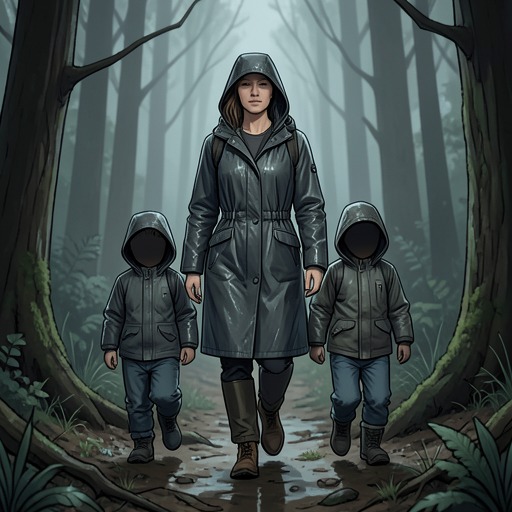
Bird BoxThe rowboat is the means by which Malorie finally leaves the house with the Boy and the Girl, and the precarious setting for much of their journey toward a safer place. Discovered years before their escape and kept ready nearby, it offers a route out of confinement without offering safety: its rocking hull, the river’s sounds, and the threat of collision or attack continually turn the boat from a practical object into a test of how far the family can travel while blindfolded.
Discovery and Preparation
Malorie found the rowboat docked five houses from her home four years before she used it to escape. More than a month has passed since she last checked it, and her confidence that it remains there competes with the imagined possibility that another desperate person has taken it. In that imagined alternative, the boat is not merely equipment but a point of salvation for anyone who has spent years gathering the courage to flee. Its distance from the house is short; reaching it is nevertheless the culmination of a long delay.
The boat’s place in the escape plan is measured against the emptied street around Malorie’s home. She trusts that it is still at the dock just as she trusts that the cars remain parked outside and the houses remain empty. But those familiar facts do not resolve what waits on the river. The craft is a possible way forward, not proof that the world beyond the house is safe.
The contrast between the secure interior and the river is already present in the housemates’ discussion of where they could retreat if a creature entered. One argues that the attic door’s strong bolt would make the attic safer than the delicate cellar lock. Against that image of a refuge secured by a door, the rowboat offers no enclosing barrier: once the family launches, its safety depends on remaining alert and moving through an exposed environment.
Boarding and Launch
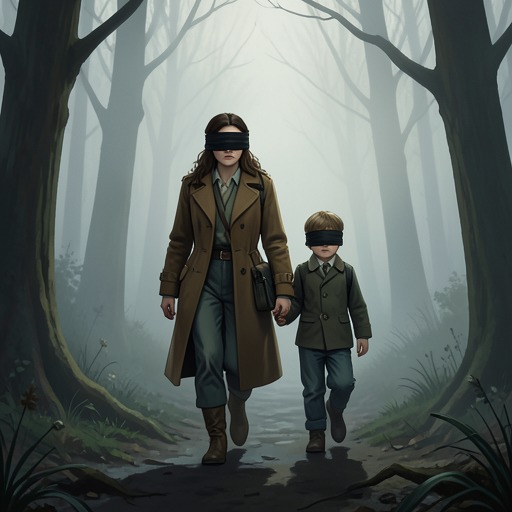
Before the family reaches the dock, Malorie hears the boat rocking in the water. She stops to tighten both children’s blindfolds, then leads them onto the planks. Away from the woods and house, the air feels colder; the water’s sound is at once frightening and exhilarating. Kneeling where she believes the boat to be, she searches by touch and finds the rope before the pointed steel tip.
Malorie draws the ice-cold bow toward the dock and puts the Boy in the front. Once he is steady, she holds his face in both hands and tells him to listen beyond the water. She keeps the Girl on the dock while she unties the rope, climbs onto the middle bench, and helps the Girl aboard. When the boat rocks violently, Malorie grips the Girl’s hand too tightly; the Girl does not cry out. Even the act of boarding requires the children to endure instability without being able to look at its cause.
The bottom is littered with leaves, sticks, and water. Malorie searches through them for the paddles she has stowed on the boat’s right side. They are cold and damp, with a mildew smell, but feel strong and sturdy when she sets them into the steel grooves. One paddle pushes the boat away from the dock. The departure is marked by a blunt change of state: the family is on the river, with calm water beneath them and movement audible in the woods. Malorie hopes the fog conceals their escape.
A Route Governed by Sound and Risk
The rowboat makes hearing a practical navigation tool, but sound cannot guarantee what a sound means. When Malorie hears an engine far beyond the river’s flow, she recognizes another boat approaching. The prospect of encountering another person does not reassure her; she is afraid. The river can carry the family toward help or toward an unknown threat, and the boat gives her no visual means to tell which.
The danger of the river is also discussed from the house. When Felix asks whether they can drink its water, Don raises bacteria as a concern. Tom answers that the risk depends on how cold, deep, and fast the water is, while Jules reasons that if something contaminated the well, it may have reached the river too. The exchange does not establish that the rowboat’s water is safe to drink; instead, it shows how uncertain the river remains even to people considering it from shelter.
That uncertainty becomes physical when the bow strikes something hard. Malorie shrieks, and both children scream. She realizes the boat has run into the bank and jabs a paddle toward where she believes the mud to be, without making contact. The hull has not simply carried them along a route: its collision interrupts movement and leaves Malorie to find her bearings through sound and touch.
Later, a pack of wolves closes on the boat. Its tip is caught on something Malorie cannot locate with her paddle, and the hull swivels as if the animals have seized the bow. She fears they could jump in. Rising and swinging a paddle above the children, she makes the boat lean sharply to the right and has to steady herself. A wolf attack turns the boat’s narrowness into an immediate liability: the children are within reach of danger, while Malorie cannot see the obstruction or reliably free the craft. Her shoulder is badly wounded as she tries to defend them and reach the bow.
The Boat as Refuge and Burden
In the boat, the family’s dependence on touch and hearing is exacting rather than abstract. The children remain blindfolded; Malorie tells the Boy to stop talking unless he hears something. Their quiet lets her distinguish the Boy breathing in front of her and the Girl handling puzzle pieces in the back. When the Boy says his blindfold no longer hurts, Malorie’s response is a rule about listening, not a promise that the journey has become easier.
The rowboat carries Malorie’s fear of what the children have learned to become. She has trained them to listen so closely that they can recognize a smile by sound and detect fear in her before she identifies it herself. At times, she has thought of them as small monsters or creatures in their own right. Yet their developed hearing is also a survival skill inside the boat, where an unseen bank, approaching engine, or nearby animal may matter more than anything they could see.
Malorie’s injured shoulder exposes the physical cost of relying on the craft. She has endured falls down the cellar stairs, a trip while carrying a bucket back from the well, a possible broken wrist, and other close calls during the years of danger. The wolf attack leaves the flesh of her shoulder feeling peeled from her body. She wants to stop, find a hospital, and seek a doctor, but she believes that if she dies, the children will die without her. The boat keeps them moving even when its captain’s strength is failing.
Its significance rests in that contradiction. It is a prepared instrument of escape, sturdy enough to push away from the dock and carry three people, but it is also a small, exposed space subject to hidden obstacles, uncertain water, and attack. The family’s passage depends on the same qualities that make the journey frightening: Malorie’s ability to interpret sound, the children’s disciplined listening, and the boat’s capacity to keep moving when no one can see what lies ahead.